
Complex Labour Processes
Multiple labour processes, provisions and administrative procedures needed to be translated into structured digital journeys.
SAMADHAN 2.0 — Digital Labour Dispute, Claims & Grievance Management
SAMADHAN 2.0 is a government digital platform designed to digitize labour-related applications, industrial disputes, claims, complaints and case proceedings. The platform brings multiple labour processes into structured digital workflows, enabling authorities to manage applications from submission and scrutiny through processing, resolution and closure.
Client
Ministry of Labour & Employment, Government of India
Role
Business Analyst / Application Design
Duration
National Programme
Industry
Government & Labour Administration
Enterprise Solution
SAMADHAN 2.0 — Digital Labour Dispute, Claims & Grievance Management
4
New Labour Codes
41
Digital Modules
E2E
Case Lifecycle
Rule-Driven
Digital Workflows
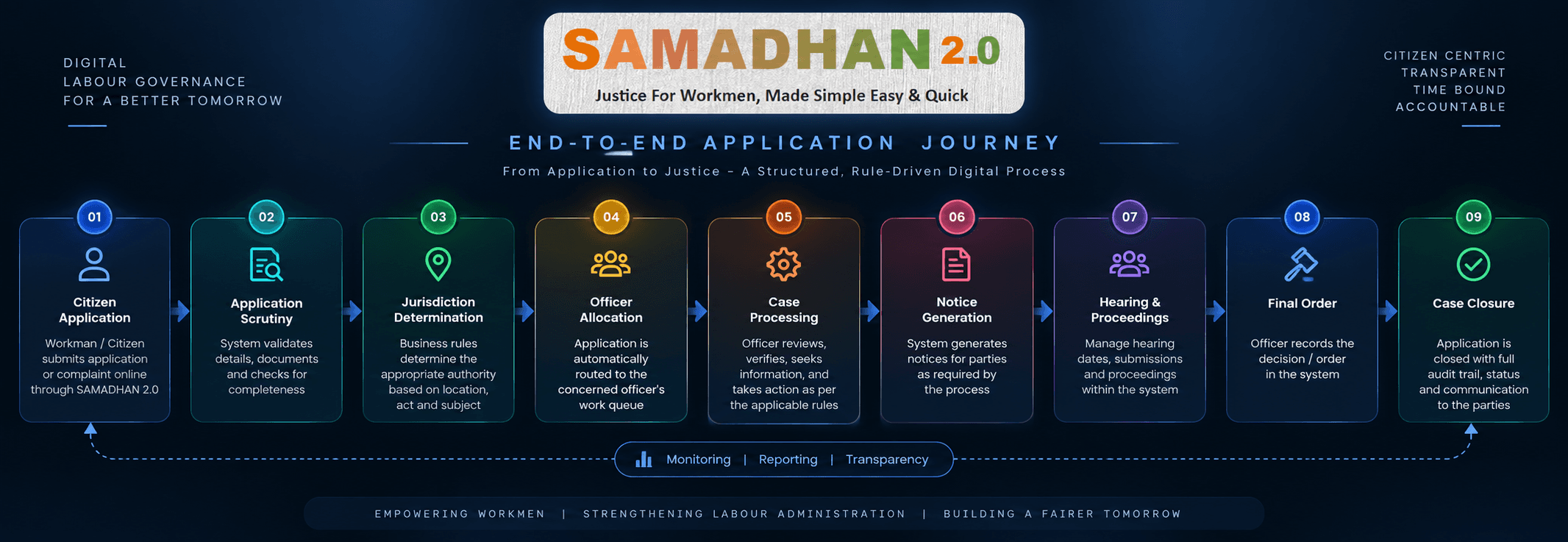
Samadhan 2.0 — End-to-End Digital Application Journey
The New Labour Code implementation required labour-related processes to be translated into structured digital journeys that could be used by workers, applicants, employers and government authorities.
The platform needed to support multiple modules, application categories, jurisdiction rules, officer workflows, case statuses and operational monitoring while maintaining a clear digital trail throughout the application lifecycle.
Multiple labour processes, provisions and administrative procedures needed to be translated into structured digital journeys.
The ecosystem involved workers, employers, officers, authorities and other stakeholders participating at different stages.
Applications needed to reach the appropriate authority and concerned officer based on applicable business and jurisdiction rules.
Authorities required a centralized workspace to monitor applications, pending actions, proceedings and outcomes.
Understand legislation, policy and operational requirements.
Analyse existing processes, stakeholders and exceptions.
Define workflows, rules, roles and functional behaviour.
Support implementation, UAT, defect resolution and release.
The platform experience is built around the complete lifecycle of a labour application rather than isolated transactions.
Worker, citizen or applicant initiates the applicable labour service or complaint.
Application information and supporting details are checked before further processing.
Applicable authority is determined based on the relevant business and jurisdiction rules.
The application is routed to the concerned authority or officer for action.
The concerned officer reviews the application and performs the applicable case actions.
Where applicable, notices, hearings, submissions and proceedings are managed.
The applicable decision or order is recorded within the digital case journey.
The case is completed with its status, actions and history maintained for traceability.
The officer experience provides a structured workspace for viewing, searching and processing applications across different labour processes and application states.
Product Experience
Application Lifecycle
Different labour processes were brought into a connected ecosystem while retaining their individual business workflows and case requirements.
A key part of business analysis was defining how applications should move through the system, who could act on them and what should happen at each stage.
Identify the applicable authority according to the nature of the application and relevant jurisdiction criteria.
Route applications into the appropriate authority or officer work queue.
Control the available actions and next stages based on application status and process conditions.
Ensure that different participants can perform the actions applicable to their responsibilities.
Maintain structured movement from application through processing, proceedings, decision and closure.
Maintain visibility of application progression and actions throughout the case lifecycle.
Central
Digital processing of applicable labour applications and cases under the relevant central-government processes.
State
Applicable state-level labour workflows and authorities within the broader digital ecosystem.
BA Perspective
The real challenge was not creating another application. It was translating complex labour processes into a digital journey that people and authorities could actually execute.
My contribution focused on understanding the business problem, analysing processes, defining requirements, converting rules into functional behaviour and supporting the technology team through implementation and validation.
The core challenge was converting labour-related requirements and administrative procedures into clear, implementable system behaviour.
The implementation covered 41 modules, each with its own process requirements, actors, validations and workflow considerations.
The digital journey needed to represent how applications are actually received, reviewed, allocated, processed and concluded.
Application processing required structured states such as accepted, proceeding, reserve, resolution and other applicable outcomes.
Digitized labour dispute and grievance processes
Structured Industrial Dispute case management
Enabled digital processing of claims and complaints
Centralized pending and disposed application visibility
Standardized application and case workflows
Improved traceability across application lifecycle
Reduced ambiguity during development
Improved stakeholder collaboration and requirement clarity
For digital government systems, requirements ultimately need to become validations, decisions, workflow transitions and system actions.
Good functional design starts by understanding the real business process before designing screens or technical solutions.
The value of a case-management platform comes from controlling the journey and ensuring every stage has clear ownership and action.
For government applications, visibility of status, actions and case progression is critical for operational accountability.
SAMADHAN 2.0
A digital transformation initiative focused on bringing complex labour processes into structured, transparent and traceable digital workflows.